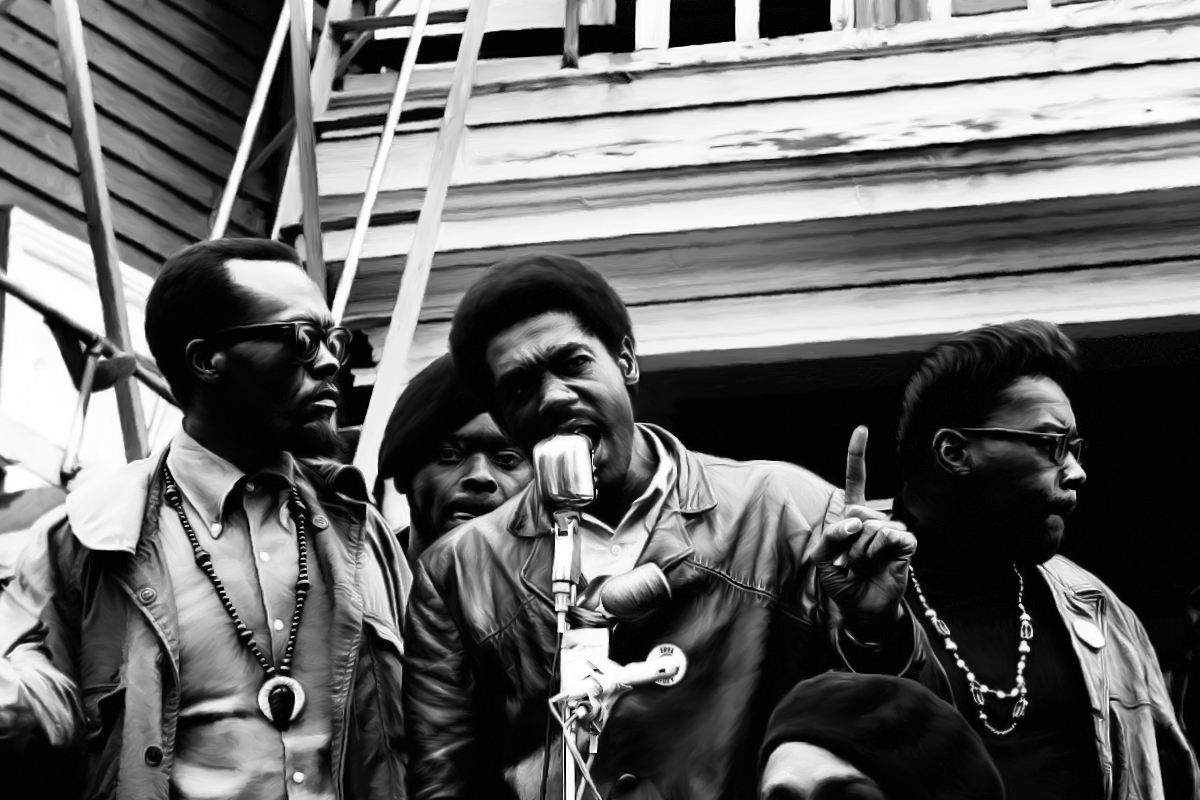
In October of 1966, in the wake of the assassination of black leader Malcolm X and on the heels of the massive urban uprising in Watts, California and at the height of the civil rights movement led by Rev. Dr. Martin Luther King, Jr., Huey P. Newton gathered a few of his longtime friends, including Bobby Seale and David Hilliard, and developed a skeletal outline for this organization.
Originally named the Black Panther Party For Self-defense, the Panthers practiced militant self-defense of minority communities against the U.S. government, and fought to establish revolutionary socialism through mass organizing and community based programs. The black panther was used as the symbol because it was a powerful image, one that had been used effectively by the shortlived voting rights group the Lowndes County (Alabama) Freedom Organization.
The party was one of the first organizations in U.S. history to militantly struggle for ethnic minority and working class emancipation - a party whose agenda was the revolutionary establishment of real economic, social, and political equality across gender and color lines. Black Panther Party objectives and philosophy expanded and evolved rapidly during the party's existence, so ideological consensus within the party was difficult to achieve, and some prominent members openly disagreed with the views of the leaders.
The organization's official newspaper, The Black Panther, was first circulated in 1967. Also that year, the Black Panther Party marched on the California State Capitol in Sacramento in protest of a selective ban on weapons. By 1968, the party had expanded into many cities throughout the United States. Peak membership neared 10,000 by 1969, and their newspaper, under the editorial leadership of Eldridge Cleaver, had a circulation of 250,000. The group created a Ten-Point Program, a document that called for ‘Land, Bread, Housing, Education, Clothing, Justice and Peace’, as well as exemption from conscription for African-American men, among other demands. With the Ten-Point program, ‘What We Want, What We Believe’, the Black Panther Party expressed its economic and political grievances.
Gaining national prominence, the Black Panther Party became an icon of the counterculture of the 1960s. Ultimately, the Panthers condemned black nationalism as “black racism” and became more focused on socialism without racial exclusivity. They instituted a variety of community social programs designed to alleviate poverty and improve health among inner city black communities as well as soften its public image. The Black Panther Party's most widely known programs were its armed citizens' patrols to evaluate behavior of police officers and its Free Breakfast for Children program. However, the group's political goals were often overshadowed by their confrontational, militant, and violent tactics against police.
Conflicts between Black Panthers and police in the late 1960s and early ‘70s led to shoot-outs in California, New York, and Chicago, one of which resulted in Newton going to prison for the murder of a patrolman.
By the mid-1970s, having lost many members and having fallen out of favor with many American black leaders, who objected to the party's methods, the Panthers turned from violence to concentrate on conventional politics and on providing social services in neighborhoods. The party was effectively disbanded by the early 1980s.
Biography credit: The Black Panther Party, https://www.blackpanther.org/legacynew.htm